
What are the most common HVAC issues in Boise? When you live in Meridian/Boise, you want to ensure your HVAC works in the summer and winter. Clogged air filters, thermostat issues, refrigerant leaks,s and blocked drains are often the culprits of minor HVAC problems.
There is also that “Feel-good” issue we all experience, because let’s face it, every house has that one room. Too hot in July, freezing in January, and two generations of the family have argued about it. Around the Treasure Valley, that room usually has company, because the most common HVAC issues in Boise are not random bad luck. They show up on schedule, Groundhog Day style, with worse timing. Cottonwood in May. Smoke in August. Buried vent pipes come in January.
Walk the year with us, and you will know what is coming, and which parts you can handle yourself with a Saturday and a garden hose.
Quick Summary: Common HVAC Issues in Boise
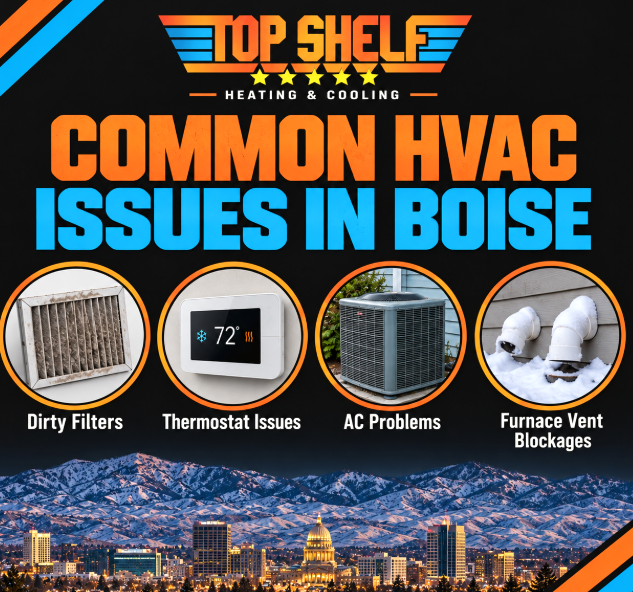
The most common HVAC problems in Boise include dirty air filters, clogged outdoor AC coils, thermostat issues, refrigerant problems, blocked furnace vents, frozen condensate lines, and seasonal wear caused by Treasure Valley weather. Cottonwood and dust can restrict AC airflow in spring, extreme heat stresses cooling systems in summer, and snow or ice can block high-efficiency furnace vents during winter. Regular filter changes, keeping outdoor equipment clear, and seasonal HVAC maintenance can help prevent many of these problems before they turn into emergency repairs.
Spring HVAC Issues in Boise (AC):
May in Boise looks like it is snowing sideways, and your air conditioner is standing outside catching all of it.
Cottonwood fluff mats across condenser fins like felt. Dust drifts in from the fields around Nampa and Kuna. Construction grit hangs over half the valley. Every bit of it settles on the one component whose whole purpose is throwing your home’s heat outside, and a coil wearing a sweater cannot throw much of anything. The system runs longer, works harder, and delivers less. An ASHRAE study of a large central system measured a 10 to 15 percent performance gain from simply cleaning the coils.
The good news is that this one is genuinely yours to fix. Kill power at the disconnect, rinse the fins gently with a garden hose from the inside out, and keep two feet of breathing room around the unit. Skip the pressure washer, which folds fins flat and turns your afternoon of helpfulness into a repair bill.
Spring is also when people find out their AC did not survive the winter. Testing it on a mild April afternoon beats discovering the problem during the first 95-degree stretch in June, when half the valley is calling at once. A spring maintenance visit mostly exists to spare you that experience.
Three things worth noticing once it warms up:
- Weak airflow at the vents, which usually means a loaded filter or dirty coil rather than anything expensive.
- The outdoor unit humming along while the indoor air stays lukewarm, which points toward refrigerant or the compressor.
- Grinding, squealing, or rattling outside, almost always a bearing or fan issue that costs little if caught early and plenty if ignored.
Summer: Extreme Heat, Wildfire Smoke, and Systems That Never Get a Break
Boise summers ask a lot, and two problems dominate what we see.
The first is plain exhaustion. When afternoons park above 100 degrees, an AC sized for average conditions runs nearly nonstop, and every component that was quietly limping along picks that exact week to quit. Capacitors fail. Contactors burn. The system that seemed fine in June suddenly cannot keep up, and AC repair calls stack up across the valley within hours of a heat spike. Nobody plans for this, and everybody needs it on the same Tuesday.
The second problem blows in on the wind.
Wildfire Smoke Changes Your Filter Math
You know the summer mornings when the light through the kitchen window has gone strange and orange. Smoke season is part of the Treasure Valley calendar now, and it temporarily rewrites the rules on filtration.
Normally, MERV 8 to 11 is right for a home system, balancing filtration against airflow. During smoke events, the EPA recommends MERV 13 or higher, because MERV 11 and below let fine PM2.5 particles sail right through. Most systems built after 2000 handle MERV 13 without complaint, on one condition the EPA states plainly: replace the filter often.
Often means more often than you would guess. Heavy smoke can load a MERV 13 in 30 to 45 days, and ASHRAE guidance published through the EPA notes that severe events may require replacement as often as daily. Check yours every couple of weeks when the sky looks wrong.
Two things to know before you go filter shopping:
- Bigger numbers are not automatically better. One manufacturer studied over 1,200 filters after a wildfire season and found homeowners running MERV 16 ended up with worse indoor air than those running MERV 13 and changing it regularly. Their blowers simply could not move air through the denser media. A MERV 13 breathing freely beats a MERV 16 strangling your system.
- Older equipment deserves a check first. Furnaces with PSC blower motors can struggle against the resistance, and a pressure drop past 0.5 inches of water column risks the motor or cuts your capacity.
The EPA also suggests flipping your fan from “Auto” to “On” during smoke events, which keeps air moving through the filter instead of only when the system is actively cooling. Switch back to your normal filter afterward. If smoke has become a yearly ordeal in your household, especially with kids or anyone with asthma, whole-home air quality equipment does far more than swapping a filter ever will.
Fall: The First Furnace Run Tells You Everything
That first genuinely cold October morning is the most honest test your heating system gets all year.
Systems that sat untouched for six months speak up immediately. A burning smell on the first ignition is usually just dust cooking off the heat exchanger, and it clears within an hour. Nothing to worry about. A smell that lingers, or a burner flame burning yellow or orange instead of a clean blue, means incomplete combustion and deserves a call that day rather than a note on the fridge.
What the other first-run symptoms usually mean:
- Starts, runs briefly, shuts off, repeats. Short cycling, often from a dirty filter, a tired flame sensor, or a thermostat reading the wrong temperature.
- Blower runs, air stays cool. Usually ignition or gas supply, not the blower itself.
- Nothing happens at all. Check the furnace switch and the breaker before calling anyone. A surprisingly large number of no-heat calls end with a switch somebody bumped with a laundry basket, and we would rather you keep that money.
- One room warm, another freezing. Usually airflow or duct balancing, not a failing furnace.
Fall is also the last relaxed window to book heating maintenance before everyone else remembers they have a furnace. Our winterizing guide walks the full checklist if you would rather handle it yourself.
Winter: Nine Degrees and the Trouble It Brings

Boise’s winter design temperature sits near 9 degrees, which is the number your heating system has to hold the house against. Three failures cluster right here.
Buried intake and exhaust pipes. High-efficiency condensing furnaces, meaning most units installed in the last fifteen years, breathe through two white PVC pipes poking out of an exterior wall a foot or two off the ground. Snow drifts against them. Ice creeps across the openings. Someone clears the driveway and stacks the pile right on top. Block either pipe and the pressure switch shuts everything down, which is your safety system doing its job while your house gets cold anyway. Go find those pipes this weekend and keep a clear pocket around them all winter. Thirty seconds now, no 6 a.m. phone call later.
Frozen condensate lines. Condensing furnaces make water, and a drain line running through an unheated garage or crawl space will freeze and stop the whole show.
Heat pumps that seem broken but aren’t. Heat pumps run defrost cycles in cold weather, complete with steam, unfamiliar noises, and a brief cool draft indoors. Perfectly normal, though it startles people every single winter. Ice that never clears between cycles is the real problem. Our 2026 heat pump rankings cover how cold-climate models handle our winters, because a properly specified unit holds its capacity well below freezing.
One more winter note: our inversions hold stagnant, particulate-heavy air over the valley for days at a stretch. Your filter works considerably harder in January than it does in June, so check it more often than the box suggests.

⬅️ Learn about the Top Shelf Heating & Cooling team that is locally owned and operated here in Meridian!
Common Water Heater Issues in Boise:
Two problems ignore the calendar entirely…
Treasure Valley water runs hard, commonly 10 to 13 grains per gallon in Boise, which the USGS files under very hard. Those minerals settle inside your water heater and build a crust across the tank bottom that holds heat against the steel, producing the popping and rumbling homeowners describe as their water heater talking to them. Annual flushing genuinely extends tank life here in a way it might not in a softer-water city, which is why water heater service matters more in this valley than most. The same scale shortens the life of tankless units unless you descale them yearly.
Then there is the thermostat, the smallest component in your house and the source of more family conflict than any appliance deserves. Before anyone gets blamed, check where it’s mounted. A thermostat sitting in direct sun, above a lamp, or on an exterior wall reads a temperature nobody else in the house is experiencing, and your system dutifully chases a number that is not real. Placement solves more of these arguments than replacement does, though a modern thermostat with better sensing helps. Our guide to the best indoor temperature settings is worth a look if your bills feel higher than they should.
Which Common HVAC Issues in Boise Need a Call Today
When do you have an HVAC emergency, and when can you wait on an HVAC issue?
Sorting urgent from annoying saves you money, but it also helps prevent a small HVAC issue from becoming a big one! You have to consider your safety and also the timing of your issue, but be sure to always have a professional HVAC tech help you with the following:
| Call right away | Fine to schedule |
|---|---|
| No heat with outdoor temperatures below freezing | Uneven temperatures room to room |
| Any gas smell near the furnace | Higher bills, system still running |
| Yellow or orange burner flame | Noisy but working |
| No cooling during a heat advisory | A thermostat that seems a little off |
| Water pooling around the furnace or water heater | Filter due for a change |
| Burning smell lasting beyond the first hour | Frost that clears during a defrost cycle |
Gas smells, carbon monoxide alarms, and a house losing heat in real cold belong in the emergency service column no matter what the clock says. Call. That is what 24 hours a day means.
Schedule Routine HVAC Maintenance Yearly:
The reassuring part about the common HVAC issues in Boise is how predictable they are. Cottonwood comes every May. Smoke shows up most Augusts. Snow finds those vent pipes every winter without fail. Systems looked at twice a year, once before cooling season and once before heating season, spend far less time surprising their owners at terrible hours.
Pick whichever season is closest and start there. If your AC has not been touched since last summer, or your furnace has not run since March, congratulations, you have found your appointment. Top Shelf Heating & Cooling is family-owned, based right here in Meridian, and we answer the phone at 2 a.m. because that is when furnaces like to quit. We cover Boise, Meridian, Nampa, Eagle, Garden City, Middleton, Mountain Home, and the rest of the Treasure Valley at 208-572-9016. Check out our current specials while you decide, and get that snow pile off your vent pipes.
Frequently Asked Questions
1. What is the most common HVAC problem in Boise?
Dirty air filters and restricted airflow are among the most common HVAC issues we see in Boise and across the Treasure Valley. Dust, cottonwood, wildfire smoke, and everyday household debris can clog filters and outdoor coils, causing your system to work harder and making heating or cooling less effective.
2. Why does my AC struggle during Boise summers?
During stretches of 95 to 100 degree weather, your AC may run for long periods just to maintain the temperature inside your home. Dirty condenser coils, weak capacitors, refrigerant problems, clogged filters, or an aging system can make it even harder for the AC to keep up.
3. Why does my furnace stop working when it gets really cold?
Boise winters can cause several furnace problems, especially with high-efficiency systems. Snow or ice can block exterior intake and exhaust pipes, condensate lines can freeze, and worn ignition components may fail when the furnace is running frequently. Always keep exterior furnace vents clear during snowy weather.
4. How often should I change my HVAC filter in Boise?
For most Treasure Valley homes, checking your filter every 30 to 60 days is a good starting point. During wildfire smoke, heavy dust, construction, or periods when your system runs constantly, you may need to inspect and replace it more often. The right schedule also depends on the filter type and your HVAC system.
5. When should I call for emergency HVAC service in Boise?
Call for HVAC service right away if you smell gas, your carbon monoxide detector goes off, your furnace stops working during freezing weather, your AC completely fails during extreme heat, you notice water pooling around your furnace or water heater, or you see a yellow or orange furnace flame. Top Shelf Heating & Cooling provides 24/7 emergency HVAC service throughout Boise, Meridian, Nampa, Eagle, and the Treasure Valley.

 What Is the $5,000 Rule for HVAC, and Does It Still Work in 2026?