

What are the best tankless water heater brands for your home? That is a question we aim to answer for you today!
Your tank heater picks a Tuesday in January to die. The replacement quote mentions “tankless,” and suddenly you’re deep in GPM charts at 11 p.m. wondering if you’ll ever get a hot shower again. I’ve replaced a lot of water heaters across Meridian, Nampa, and Boise, and these are the tankless water heater reviews I actually stand behind, ranked for real homes.
Here’s the part most lists skip: the “best” unit isn’t the biggest number on the box. In the Treasure Valley, it’s the one sized for our cold, hard groundwater and built to be flushed easily. Let me explain why, then give you the picks.
What actually makes a tankless water heater “the best” here?
Three specs decide whether a unit works in your house, and none of them is brand loyalty. Flow rate (GPM) is the amount of hot water the unit can produce at once. UEF (Uniform Energy Factor) is how efficiently it turns fuel into hot water. And temperature rise is the quiet one that trips up every generic review, because it’s where our climate wrecks the marketing math.
Here’s the trap. The GPM number on the box assumes a 77-degree temperature rise. Our incoming groundwater in the Treasure Valley runs cold, often in the 40s to low 50s much of the year, and you want water at 120. That’s a rise closer to 70 to 80 degrees, so a unit rated “11 GPM” in a Georgia lab delivers noticeably less here. This is exactly why I’ve watched electric tankless units disappoint in Idaho homes. At a 70-degree rise, an 18kW electric unit that promises 3.5 GPM in Florida drops to under 2 GPM here. That’s one slow shower and nothing else running.
The other local reality is water you can almost chew. Treasure Valley hardness runs high: Boise commonly tests at 10 to 13 grains per gallon (USGS calls anything over 10.5 “very hard”), Meridian at around 8.4, and even Eagle, the softest around here, at 6 to 9. That mineral load scales up a tankless heat exchanger fast, and scale is the number one killer of these units locally. So my picks weigh descaling access and warranty as heavily as raw output.
The best tankless water heaters, ranked for real homes
I’ve grouped these by the home they actually fit, because the right answer for a 4-bath house is wrong for a downtown condo. Specs below are manufacturer-published; the rankings reflect field reliability and how these units behave in cold, hard water, not a lab bench.
| Rank | Model | Type | Max GPM | UEF | Heat exchanger warranty | Best for |
|---|---|---|---|---|---|---|
| 1 | Rinnai RX199iN | Condensing gas | ~11.1 | 0.96 | 15 yr | Most Treasure Valley homes, 3 to 4 baths |
| 2 | Navien NPE-240A2 | Condensing gas | ~11.2 | 0.97 | 15 yr | Big families, cold-water-sandwich haters |
| 3 | Rheem RTGH-95DVLN | Condensing gas | ~9.5 | 0.93 | 12 yr | Value pick, 2 to 3 baths |
| 4 | Rinnai RU199iN | Condensing gas | ~11 | 0.96 | 12 yr | Whole-home workhorse, add-on recirc |
| 5 | EcoSmart ECO 27 | Electric | ~3 to 4 (cold climate) | 0.99 | Limited lifetime (residential) | No gas line, small or point-of-use loads |
1. Rinnai RX199iN: the one I recommend most
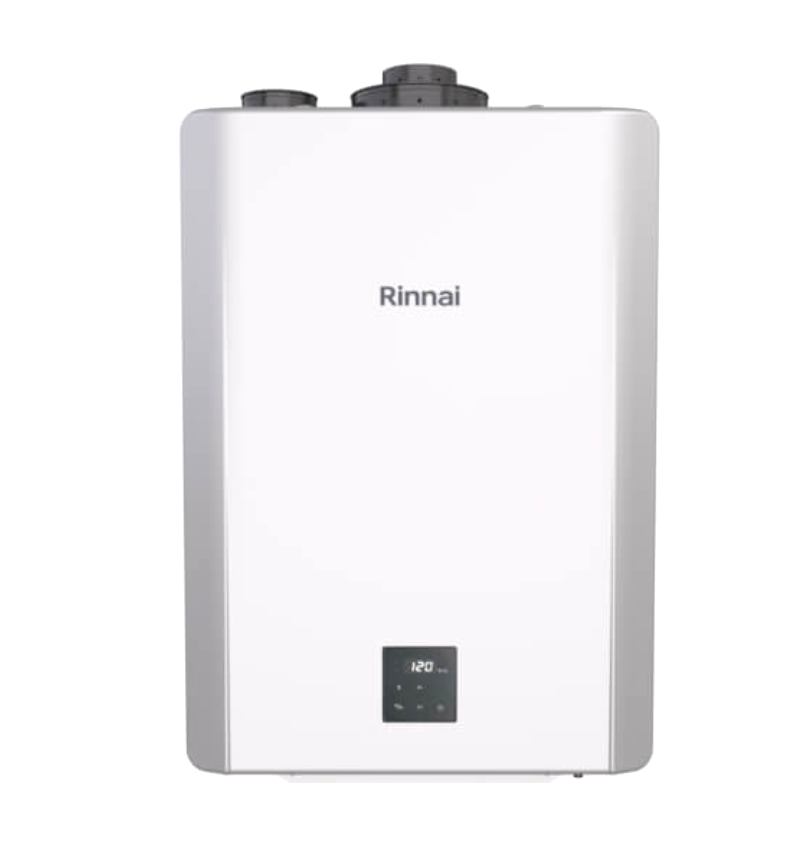
For a typical Treasure Valley home with three or four bathrooms, this is my default. It’s a condensing unit around 0.96 UEF and 11.1 GPM, which handles two showers plus a dishwasher without the temperature sagging, and Rinnai runs the largest service and parts network in the country, which matters when a flow sensor fails on a Sunday.
The 15-year heat exchanger warranty is among the best you’ll find. One honest quirk: it makes a little noise for two or three minutes after you shut the hot water off, so don’t mount it on the other side of a bedroom wall. It has no built-in recirculation pump, so if you want instant hot water at a far bathroom, budget for the add-on pump or step up to the built-in-recirc version.
2. Navien NPE-240A2: kill the cold-water sandwich
If your household runs a lot of hot water at once, or someone in the house loses their mind over the cold-water sandwich (that slug of cold that hits mid-shower when you pause the flow), this is the pick. It achieves the highest efficiency in the group, with a UEF of 0.97 and 11.2 GPM, and the built-in buffer tank and recirculation pump handle the cold-sandwich problem without add-on parts. The tradeoff is service depth. Navien’s parts network is thinner than Rinnai’s, so a failed sensor can mean a couple days’ wait if the local supplier is out. In the Treasure Valley, that’s usually fine, but it’s worth knowing.
3. Rheem RTGH-95DVLN: the value play
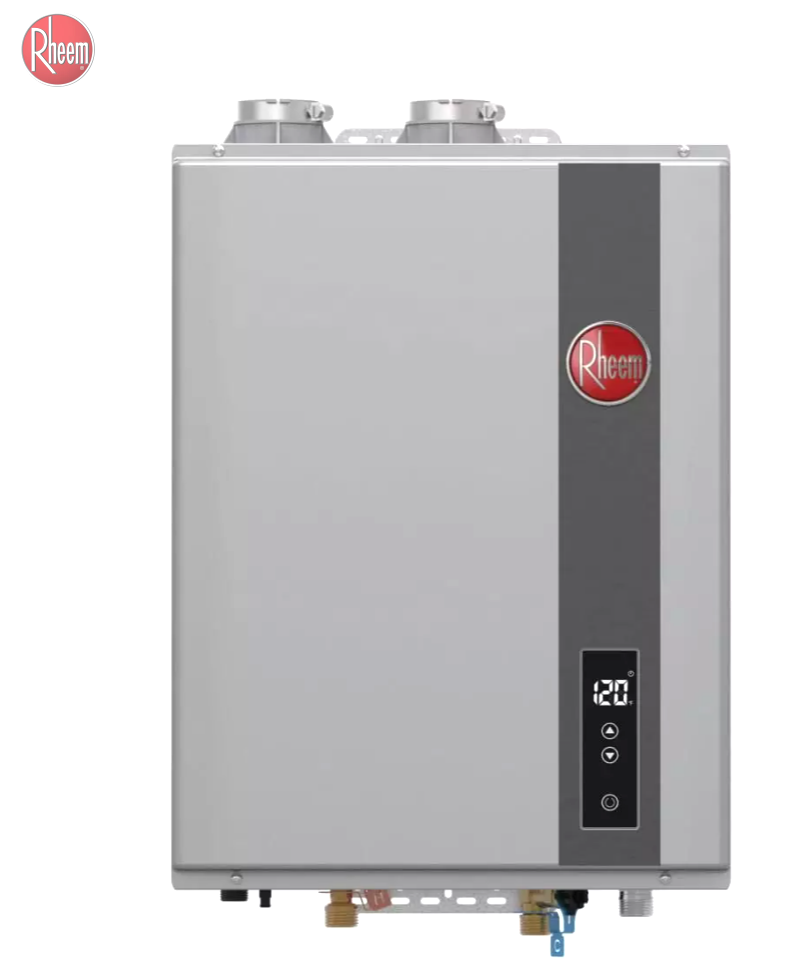
Not every home needs 11 GPM. For a two- or three-bathroom house that rarely runs more than two hot fixtures at once, this Rheem delivers about 9.5 GPM at 0.93 UEF for several hundred dollars less than the Rinnai or Navien. You give up a bit of headroom and some smart features. You keep most of the performance. Rheem’s parts availability is strong, which keeps future repairs quick.
I love installing the Rheem prodcuts for Meridian homeowners. Here at Top Shelf Heating, this is one of the go to selections for Tankless Water Heaters we recommend! ~ Kevin Costa, Owner of Top Shelf Heating & Cooling
4. Rinnai RU199iN: whole-home workhorse
Close cousin to the RX199iN, the RU199iN gives you condensing efficiency near 0.96 UEF and roughly 11 GPM at a slightly lower price, with a 12-year heat exchanger warranty instead of 15. It supports an external recirculation pump, so you can add instant hot water at distant fixtures later without replumbing. A solid choice if you want strong performance and don’t need the longer warranty.
5. EcoSmart ECO 27: only if you have no gas
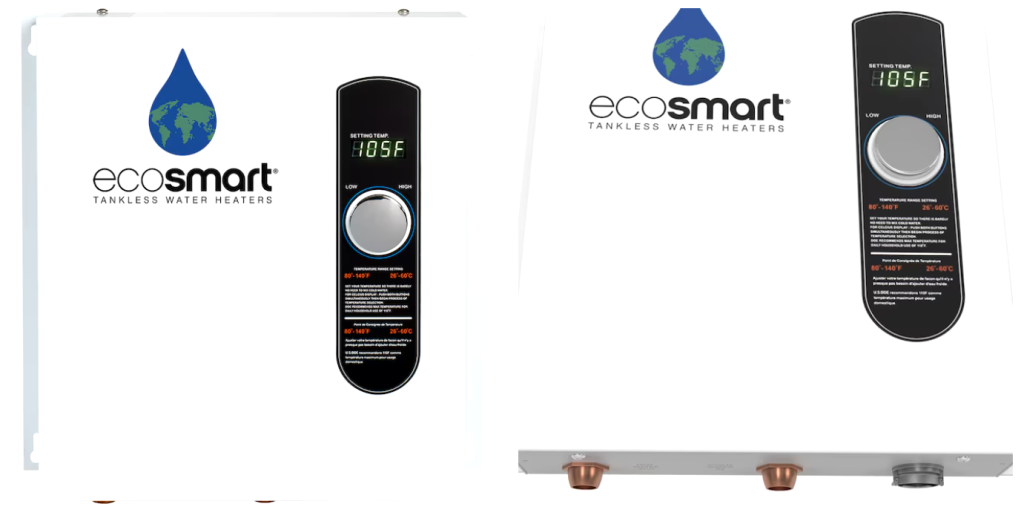
I’ll be straight. Electric tankless is a hard sell in our climate, because cold incoming water plus a big temperature rise chokes the flow rate. But if your home has no gas service and running a line isn’t practical, the ECO 27 is the most defensible electric whole-home option, with near-perfect electrical efficiency and no venting. Confirm your electrical panel can carry the load first, because these units pull serious amperage. Honestly, for a whole house in the Treasure Valley, I’d rather size you a gas unit or even talk about a heat-pump tank. For a single far-off bathroom, a small point-of-use electric unit makes more sense than fighting the whole-home math.
Gas vs electric tankless water heater: which is right?
For most Treasure Valley homes, gas wins, and the deciding factor usually isn’t the spec sheet. It’s your existing infrastructure. A gas condensing tankless pulls 180,000 to 199,000 BTU, roughly four times what your old tank used, so your gas line often needs upsizing to three-quarter inch, which runs a few hundred dollars. Electric avoids venting and gas work entirely, but our cold groundwater guts its flow rate, and a whole-home electric unit may need a serious electrical panel upgrade.
| Factor | Gas condensing | Electric |
|---|---|---|
| Flow in cold Idaho water | Strong (8 to 11+ GPM) | Weak (often under 3 GPM whole-home) |
| Efficiency (UEF) | 0.93 to 0.97 | 0.98 to 0.99 |
| Install complexity | Venting, condensate drain, possible gas line upsize | Possible panel/service upgrade, no venting |
| Best fit locally | Most whole-home Treasure Valley installs | No-gas homes, point-of-use, small loads |
Quick tankless water heater buying guide rule I give clients: size by peak simultaneous demand, not household size. A three-bathroom home running two showers plus a sink at once wants roughly 7 to 9 GPM of real-world capacity at our temperature rise, which is why the 9.5-to-11 GPM condensing units above are the sweet spot here.
What about efficiency rebates and installation cost?
Two numbers worth knowing before you buy. First, the federal 25C tax credit covers 30 percent of a qualifying tankless unit’s cost, capped at $600, but only for gas units at 0.95 UEF or higher. On this list, the Navien (0.97) and the Rinnai RX199iN (0.96) clear that bar; the Rheem at 0.93 and the RU199iN as listed do not, so confirm the exact model’s certified UEF before counting on the credit.
Second, installation cost swings on what your home already has:
- A straight gas-to-gas swap with no line or venting changes typically runs about $1,200 to $2,300 all in, and it’s the cheapest path if your existing setup cooperates.
- A full conversion from an electric tank to a gas tankless, including a new gas line and venting, more commonly lands in the $2,000 to $4,500 range.
- Add a few hundred dollars if your gas line needs upsizing to three-quarter inch, which many older Treasure Valley homes with a half-inch line to a 40,000 BTU tank will need.
One line item people forget: condensing units make acidic condensate and need a drain with a neutralizer, and they vent through cheap PVC instead of stainless. That’s a plus for install cost, but it’s a real drain line that has to go somewhere.
The maintenance most people skip (and it’s the whole ballgame here)
Here’s the part that decides whether your unit lasts 20 years or dies at 12. In water as hard as ours, a tankless heat exchanger needs an annual descaling flush, vinegar or a descaling solution circulated through it, to clear the mineral scale before it insulates the exchanger and cooks it. Skip it, and even a great unit’s lifespan drops hard. Manufacturers know this. Many warranties quietly assume you’re descaling and can push back on claims if scale did the damage.
As we tell our Treasure Valley customers: “The unit you buy matters less than the flush you skip. Hard water doesn’t care what brand is on the box.” Two things stretch a tankless heater’s life here: descale it once a year without fail, and seriously consider a whole-home water softener, because softened water can multiply the years you get out of that heat exchanger. If you install isolation valves at the same time as the unit (we do this by default), that annual flush becomes a 45-minute job instead of a repipe.
So which tankless water heater should you buy?
If you want the short version of these best tankless water heater reviews: most Treasure Valley homes are best served by the Rinnai RX199iN, families who hate the cold-water sandwich should look hard at the Navien NPE-240A2, and budget-focused two-bath homes do fine with the Rheem RTGH-95DVLN. Gas beats electric here for whole-home use nearly every time, size by peak demand rather than headcount, and treat the annual descaling flush as non-negotiable.
Your next step is simple: before you buy anything, get your incoming water temperature and your home’s peak GPM demand measured, because that’s what tells you which unit and size are right. Guessing is how people end up with cold showers. If you’re in Meridian, Nampa, Eagle, Boise, or anywhere in the Treasure Valley and want that done right, call Top Shelf Heating & Cooling at 208-572-9016 and we’ll size it for your house and your water.
Frequently Asked Questions About Tankless Water Heaters
1. What is the best tankless water heater for a Treasure Valley home?
For many homes in Meridian, Boise, Nampa, and Eagle, a high-efficiency condensing gas unit from Rinnai, Navien, or Rheem is usually the best fit. The right model depends on how many fixtures may run at the same time, your incoming water temperature, gas-line capacity, and whether you want built-in recirculation.
2. Are tankless water heaters worth it in Idaho?
Tankless water heaters can be a great option for Idaho homeowners who want continuous hot water, improved energy efficiency, and a smaller equipment footprint. However, the system must be sized for the Treasure Valley’s cold groundwater. A unit that performs well in a warmer climate may produce less hot water during an Idaho winter.
3. Is a gas or electric tankless water heater better?
Gas tankless water heaters are usually the better choice for whole-home use in the Treasure Valley because they can handle larger temperature rises and higher hot-water demand. Electric tankless systems may work well for smaller homes, individual bathrooms, or properties without gas service, but they can require a major electrical-panel upgrade.
4. What size tankless water heater do I need?
Tankless water heaters should be sized according to peak demand, not just the number of people in the home. A contractor should calculate how many showers, sinks, dishwashers, and other fixtures may run at the same time. Incoming groundwater temperature must also be considered because colder water reduces the unit’s available flow rate.
5. How often should a tankless water heater be flushed?
Most tankless water heaters in the Treasure Valley should be professionally flushed and descaled once a year. Boise-area water contains minerals that can build up inside the heat exchanger, reduce efficiency, restrict water flow, and shorten the equipment’s lifespan.
6. How long does a tankless water heater last?
A properly installed and maintained tankless water heater can often last 15 to 20 years. Annual descaling, proper sizing, clean water, and timely repairs all affect the system’s lifespan. Hard-water scale is one of the biggest threats to tankless water heaters in Meridian and the surrounding Treasure Valley.

 Best HVAC Company in Middleton, ID for 24/7 Care