
What is the $5,000 rule for HVAC? We get that question often here in Meridian and Boise, and today, the team here at Top Shelf Heating will answer it for you!
Everybody has sat in a mechanic’s waiting room doing math they didn’t want to do. A twelve-year-old car, a $2,800 transmission, worth maybe four grand. Pay it, or let it go? A dying furnace hands you that same afternoon, minus the trade-in.
The $5,000 rule for HVAC is the shorthand most people grab: multiply your system’s age by the repair quote, replace it if the total clears $5,000. Useful math. Also older than it looks. Give us four minutes and you will know where it works, where it quietly misleads you, and what to check before anyone runs your card.
How the $5,000 Rule Works
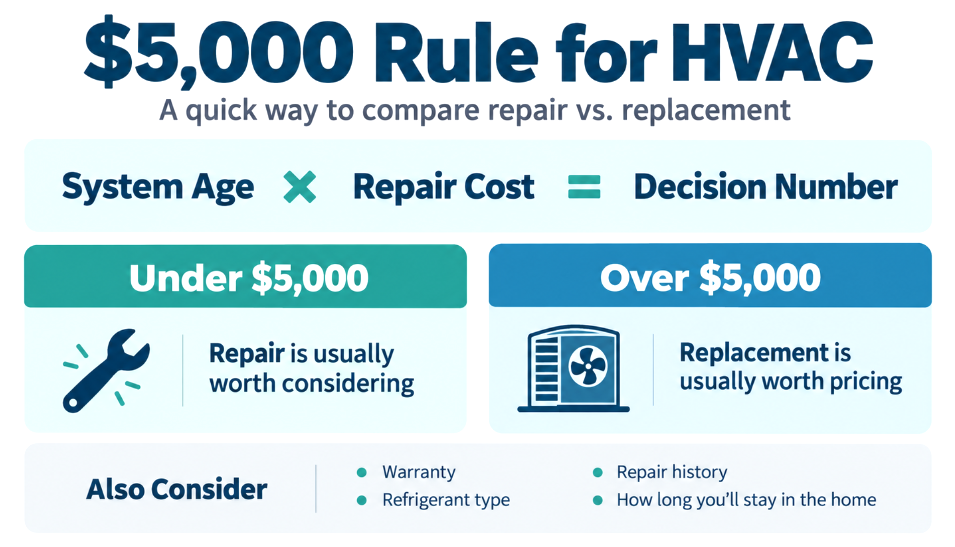
Simply put, the $5,000 rule for AC and HVAC is this: The $5,000 rule states that you should multiply your HVAC system’s age in years by the estimated repair cost in dollars; if the result is greater than $5,000, replacing the unit is usually the better financial choice (per CBS News)
The formula takes two numbers and one multiplication sign to accomplish, and it is the most accurate way to make the long-term HVAC decision that you might be struggling with.
System age in years × estimated repair cost = your decision number.
If the number is above $5,000, replacement usually wins. Below it, repair usually does. Here are some examples:
| Situation | The math | What it suggests |
|---|---|---|
| 8-year-old AC, $300 repair | 8 × 300 = $2,400 | Repair, comfortably |
| 12-year-old AC, $400 repair | 12 × 400 = $4,800 | Repair, but watch it closely |
| 12-year-old AC, $500 repair | 12 × 500 = $6,000 | Replacement worth pricing |
| 15-year-old furnace, $600 repair | 15 × 600 = $9,000 | Replace |
This rule is huge for HVAC homeowners in Boise like yourself, and it’s worth knowing where it came from, because it lends the number an authority it never earned. No manufacturer published it. No agency wrote it into code. It grew up as an industry rule of thumb, a way for technicians to walk homeowners through a stressful decision without a spreadsheet. That origin explains both why it works and why it slips.
What it does well is force age into a conversation homeowners tend to have purely about the invoice. A $700 repair feels identical on a four-year-old system and a seventeen-year-old one. The formula makes those situations produce different answers, which is the point.
Why the $5,000 Threshold Is Showing Its Age
The logic still holds. The number does not.
That threshold was set when replacement equipment cost meaningfully less than it does today. A new system for an average home now runs somewhere between $5,000 and $12,000 installed, depending on size, efficiency, and whether ductwork needs attention, and our AC replacement price guide breaks those numbers down for the Treasure Valley. Rising equipment costs, tightened efficiency standards, and a refrigerant transition have all moved since the rule was coined, and none of that movement is reflected in a fixed dollar figure from a previous decade.
Treat $5,000 as a signal flare rather than a verdict. When your math lands near it, the honest conclusion is that the decision deserves more than sixty seconds of arithmetic.
One more wrinkle the formula flattens: it treats a furnace and an air conditioner as the same machine. They are not. A gas furnace is a relatively simple appliance with a long service life, and a 15-year-old furnace needing a $500 inducer motor is often a reasonable fix. An air conditioner of the same age carries a sealed refrigerant system, an outdoor unit that has spent fifteen summers in Idaho sun, and a compressor whose replacement cost frequently approaches the price of new equipment. Same age, same repair cost, different answers, which is why heater repair and AC repair rarely follow the same logic.
The Refrigerant Change That Rewrites the Math
Something happened in 2025 that most articles about this rule have not caught up to.
The industry moved off R-410A refrigerant to lower global warming potential alternatives, primarily R-454B and R-32. New systems ship with it now, a shift we covered in our 2026 heat pump rankings. Older systems still use R-410A, and as production winds down, supply tightens and prices climb.
That shifts the economics of one specific kind of repair. A refrigerant leak on a fifteen-year-old R-410A system is a different proposition in 2026 than in 2022, because you are paying escalating prices to recharge equipment that will face the same problem again. Compressor failures on older units carry similar weight.
If the repair quote involves refrigerant and the system predates the transition, weigh your answer toward replacement, whether that means AC replacement or a heat pump. The math has not changed. The context underneath it has.
What Changed With Federal Tax Credits in 2026
Plenty of articles on this topic will tell you to offset replacement cost with the federal tax credit. That advice expired.
The Energy Efficient Home Improvement Credit, known as 25C, which returned up to $2,000 on a qualifying heat pump, was terminated by the One Big Beautiful Bill Act for anything placed in service after December 31, 2025. Equipment installed during 2025 can still be claimed on that year’s return using the in-service date. Anything installed in 2026 or later gets nothing federally, no matter when you bought it.
Idaho has no statewide replacement credit either, so the remaining savings live with utility rebate programs. Ask about current Idaho Power offers before signing anything, and check our HVAC specials and financing while you compare.
What the Formula Leaves Out
Four factors move a decision more than the multiplication does.
- Repair frequency. Three or more repairs inside three years signals a system losing efficiency across the board, regardless of what any single invoice says. A pattern beats a number, and steady AC maintenance or heating maintenance keeps that pattern from forming.
- Warranty status. An in-warranty compressor changes everything, since the expensive part arrives free and you pay labor. Check before you calculate.
- Matched components. Split systems pair an indoor unit with an outdoor one. Replacing only half creates a mismatched setup that runs less efficiently and can void warranty coverage on the new equipment, which quietly turns a cheaper decision into an expensive one. Proper HVAC installation matches components deliberately.
- How long you are staying. Five more years in the house argues for the repair. Twenty argues for the equipment that will still be running at the end of them.
Timing deserves a mention too, since Boise’s winter design temperature sits near 9 degrees. A furnace failing in January leaves you making a five-figure decision in a cold house at 6 a.m., which is not when anyone negotiates well. The same failure in October gives you a week to get quotes. When it does hit at 6 a.m., we answer emergency calls around the clock.
HVAC Replacement and Repair Numbers
The $5,000 HVAC rule helps you work through the numbers yourself vs. dealing with a high-pressure salesman. We offer free second opinions for this very reason here at Top Shelf Heating, and the purpose of a $5,000 rule is to take the emotions out of the decision!
- Find the manufacture date on the data plate, usually decoded from the serial number, since homeowners routinely guess their system’s age wrong by several years.
- Get the repair quote in writing, itemized, with the failed part named.
- Run the multiplication, then note how close the result lands to $5,000.
- Ask which refrigerant your system uses.
- Check whether any warranty remains on the equipment or the specific part.
- Count repairs over the last three years.
- Ask your contractor what a replacement would actually cost for your home, so you compare two real numbers instead of one and a guess. Our HVAC calculator is a fair starting point.
Air conditioners and heat pumps generally run 10 to 15 years, furnaces 15 to 20, and the habits that extend those numbers matter more than most homeowners expect. A system inside its expected range with one failed part is usually worth fixing. A system past that range needing something expensive is telling you something the formula only approximates.
HVAC $5,000 Rule Saves You Money:
The $5,000 rule for HVAC earns its keep as a gut check, and it fails as a final answer. Age times repair cost gets you to a reasonable starting point in about ten seconds, which is genuinely valuable when you are standing in a hallway holding an estimate. Then let the refrigerant, the warranty, the repair history, and your own timeline finish the job.
Sitting on a quote and unsure what the number is telling you? Get a second opinion that puts a real replacement figure beside the repair, so you compare like with like. Top Shelf Heating & Cooling serves Meridian, Nampa, Eagle, Boise, Garden City, Middleton, Mountain Home, and the surrounding Treasure Valley at 208-572-9016. We will tell you honestly when a repair is the smarter money, because a customer we keep for fifteen years is worth more to us than a system we sold you early.
Frequently Asked Questions About the HVAC $5,000 Rule
1. Is the $5,000 HVAC rule actually accurate?
The $5,000 rule is a useful starting point, but it should not make the decision for you. Multiply the age of your HVAC system by the repair cost. If the number is over $5,000, it may be worth comparing the repair against replacement. Warranty coverage, repair history, refrigerant type, and the overall condition of the system still matter.
2. Should I repair or replace a 12-year-old HVAC system?
It depends on what failed. A 12-year-old system that needs a relatively inexpensive repair may have several good years left. If you are dealing with a compressor failure, refrigerant leak, or repeated repairs, getting a replacement quote or second opinion usually makes more sense.
3. Does the $5,000 rule work the same for furnaces and air conditioners?
Not necessarily. Furnaces and air conditioners have different components, expected lifespans, and repair costs. A repair that makes sense on a 15-year-old furnace may not make sense on a 15-year-old AC system, especially if the air conditioner has an expensive refrigerant or compressor problem.
Should I replace an older R-410A air conditioner instead of repairing it?
Not automatically, but refrigerant should be part of the decision. If an older R-410A system has a small electrical or mechanical repair, fixing it can still make sense. If it has a major refrigerant leak or compressor problem, we would usually recommend comparing the repair cost with the cost of a new system before spending the money.

 Water Heater Emergency? Read This Before You Touch Anything