
What should you do if you have a water heater emergency in Boise, Meridian, or the Treasure Valley?
Hopefully this doesn’t happen, but imagine coming home to find water on the floor, your phone in hand, and a tank that was perfectly polite yesterday. What should you do?
Handle a water heater emergency in this order: power off first, water second. Reverse those two, and you can destroy the heating elements in about ninety seconds, which is roughly how long it takes to walk back from the breaker panel feeling productive.
Below is the triage sequence, how to read what the puddle is telling you, and the one drip you must never plug.
Water Heater Emergency Tips and Steps
Below are the tips we recommend for a water heater emergency you have. If you need to call Top Shelf Heating and Cooling, let us know, and we can help you with our emergency water heater services!
1. Cut the energy, not the water
Electric units have a dedicated double-pole breaker in your panel, usually labeled “water heater” or “WH.” Flip it off. Gas units have a control valve on the front of the tank, below the thermostat dial, which you turn to “Pilot” or “Off.”
Skipping this step can turn a bad morning into an expensive one. Once the water level inside drops below the heating elements, those elements have nothing to absorb their heat, and they burn out fast. Gas tanks fare worse. A burner firing against an empty tank can warp or crack the steel, and a dry-fired gas water heater usually gets replaced rather than repaired.
“One of the biggest mistakes we see during water heater emergencies in Boise and Meridian is homeowners shutting off the water but forgetting the power. If the tank drains while those elements are still energized, a small leak can turn into a much more expensive repair very quickly.”
— Kevin, Top Shelf Heating & Cooling
2. Shut the cold water inlet
Find the valve on the pipe entering the top of the tank. Gate valves (the round handles) turn clockwise. Ball valves (the lever type) need a quarter turn.
Refuses to budge? Stop pulling. Valves that have sat untouched for fifteen years seize, and forcing a corroded gate valve snaps the stem clean off, upgrading your one emergency into two. Walk to the main shutoff for the whole house instead and close that. Nobody has ever regretted knowing where their main shutoff lives, and plenty of people have regretted the alternative.
Water will keep draining from the tank afterward. That is fine, because you stopped the incoming supply, and a standard tank holds 40 to 80 gallons that have to go somewhere. Open a hot water tap somewhere in the house to relieve pressure and speed things along.
Quick Water Shutoff Checklist for Boise & Meridian Homeowners
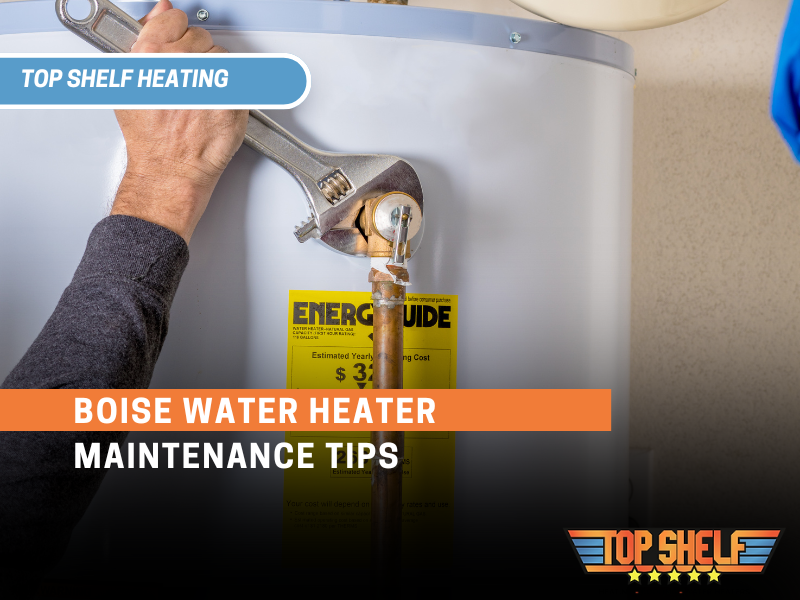
If your water heater is actively leaking, follow these steps after shutting off the power or gas, but remember to call an expert ASAP! Don’t try to repair your water heater; instead, get professional help if you live in Meridian, Boise, or the Treasure Valley!
- Locate the cold water inlet: Look for the pipe entering the top of your water heater.
- Close the water heater valve: Turn a round gate valve clockwise or rotate a lever-style ball valve 90 degrees until it is perpendicular to the pipe.
- Do not force a stuck valve: Older Boise and Meridian homes may have shutoff valves that have not been touched in years. Forcing one can break the valve and create another leak.
- Use your home’s main shutoff if needed: If the water heater valve will not close, shut off the main water supply to the house.
- Open a hot-water faucet: This relieves pressure in the tank and lets the remaining water drain more safely.
- Keep the power off: Don’t turn the electric water heater breaker back on until you know the tank is completely empty.
- Call for help if water keeps spreading: Top Shelf Heating & Cooling provides 24/7 emergency water heater service throughout Boise, Meridian, and the Treasure Valley.
Local homeowner tip: If you don’t know where your home’s main water shutoff is, find it before you have an emergency. A few minutes today can prevent significant water damage later.
3. Move your belongings away from your water heater
Move boxes, laundry, paint cans, and anything cardboard. Mold gets established in a dark closet within 24 to 48 hours, so airflow and dry towels matter more than they feel like they should.
Two hazards deserve respect while you work. Water leaving that tank sits somewhere between 120 and 140 degrees, and at 140 a child’s skin burns in under five seconds. On gas units, standing water around the burner chamber disrupts the draft, which can push carbon monoxide back into your living space instead of up the flue. Wet plus gas plus combustion is a combination to walk away from, not investigate.
| What to Check | What Boise & Meridian Homeowners Should Do | Why It Matters |
|---|---|---|
| Cardboard boxes | Move them immediately | Cardboard absorbs water quickly and can hold moisture against walls and floors |
| Furniture and storage | Move items several feet away | Creates room to access the tank and limits property damage |
| Towels or absorbent materials | Use them to contain small amounts of water | Helps slow the spread while the water supply is shut off |
| Standing water | Avoid electrical outlets, cords, and appliances nearby | Water and electricity create a serious shock hazard |
| Gas water heater | Stay away if you smell gas | Leave the area and contact the appropriate emergency service |
| Hot water | Avoid direct skin contact | Tank water may be hot enough to cause serious burns |
| Wet flooring or drywall | Begin drying the area as soon as it is safe | Moisture left behind can contribute to mold and structural damage |
| Floor drain | Make sure it is not blocked | Gives leaking water somewhere safer to travel when available |
What if my water heater has a puddle?
Reading the puddle – that is never a good thing when you see a puddle around your water heater. Where the water shows up narrows the diagnosis considerably. Not every water heater leak means you need to replace the tank.
The source of the water is often the first clue. A small leak from a fitting at the top of the tank may be repairable, while water collecting underneath the tank can indicate that the internal steel tank has corroded through. For Boise and Meridian homeowners, identifying the source quickly can help you determine whether you are dealing with a routine repair or a true water heater emergency.
Before touching anything, shut off the power or gas and look for where the water first appears. Do not assume the lowest wet spot is the source because water can run down pipes and the outside of the tank before reaching the floor.
| What you see | Likely cause | How urgent |
|---|---|---|
| Water pooling at the base of the tank | Tank corroded through | Replacement, today |
| Drip from the pipe running down the side | T&P valve discharging | Do not plug it, call today |
| Wet only at a pipe connection up top | Loose or failed fitting | Often a straightforward repair |
| Water near the drain valve at the bottom | Drain valve failure | Repairable, still needs attention |
| Popping or rumbling, no leak yet | Sediment cooking on the tank bottom | Schedule a flush soon |
Puddles at the base carry the worst news. Tanks rust from the inside out, so by the time water appears at the bottom, the steel has already lost. No patch, sealant, or optimistic epoxy fixes that, and anyone promising otherwise is selling you time, not a repair.
The drip you must never plug
That small pipe running down the side of your tank connects to the temperature and pressure relief valve, and it is the single most important safety device in your utility closet. Residential T&P valves typically open at 150 psi or 210 degrees, dumping water to keep the tank from becoming something considerably more exciting than an appliance.
Every year, homeowners discover a drip and solve it with a cap, a plug, or an ambitious wrap of tape. Investigators looking into residential water heater explosions frequently find tampered or missing T&P valves as a contributing factor. Plumbing codes even require the discharge pipe to be left unthreaded at the end so nobody can screw a cap onto it, which tells you how often people try.
Dripping still means something is wrong, so track down the cause instead:
- Thermal expansion is the most common culprit. Homes with a pressure-reducing valve or backflow preventer run closed systems, so heated water has nowhere to expand, and pressure climbs until the valve vents. The fix is a thermal expansion tank, not a new relief valve.
- Excessive incoming pressure shows up on a gauge in minutes and usually points toward a failing pressure-reducing valve.
- Overheating produces heavy discharge rather than a drip, and it means the thermostat needs attention immediately.
- Mineral scale fouls the valve seat so it cannot reseal, which brings us to the local problem.
Why Treasure Valley water is hard on water heaters

Our water runs hard. Boise commonly tests between 10 and 13 grains per gallon, which the USGS classifies as very hard, and the rest of the valley is not far behind.
Every gallon heated in your tank leaves behind calcium and magnesium. That sediment builds into a crust on the tank bottom, where it holds heat against the steel and produces the popping and rumbling people describe as their water heater “talking.” Those same minerals collect around the T&P valve seat, and a single flake of scale lodged in that seal can cause a nuisance drip that gets misdiagnosed as a failing valve.
Annual flushing genuinely extends tank life here in a way it might not in a soft-water city. Once heavy sediment has fouled a valve, though, replacement is usually the honest answer rather than cleaning.
Should you repair or replace your water heater?
Homeowners around Boise often ask us, “Should I replace or repair my water heater?” In most cases, age settles most of these decisions before anyone opens a toolbox. Tanks generally run eight to twelve years, and our hard water pushes local units toward the shorter end of that window.
- Under eight years with a leak at a fitting or valve: usually worth repairing, since the tank itself still has life left.
- Under eight years, leaking from the base: the tank has corroded through, and repair is not an option, though warranty coverage may still apply, so dig out your paperwork before authorizing anything.
- Past ten years with any tank leak: replacement, and putting money into a repair here tends to buy you a few months.
- Repeated repairs on the same unit: each one is rent rather than ownership.
Anyone quoting you a patch on a tank that leaks from the bottom is describing a delay, not a fix. Steel that has rusted through from the inside does not come back.
Use this quick checklist to get a better idea of what your Boise or Meridian water heater may need.
| Check | Repair May Make Sense | Replacement May Make More Sense |
| Age of water heater | Less than 8 years old | 10+ years old |
| Location of leak | Pipe fitting, drain valve, or replaceable component | Water leaking directly from the bottom or tank body |
| Tank condition | No visible corrosion on the tank | Rust, corrosion, bulging, or deterioration |
| Repair history | First significant repair | Multiple repairs in the past few years |
| Hot water performance | Normally keeps up with household demand | Frequently runs out of hot water |
| Water appearance | Water remains clear | Rusty or discolored hot water |
| Noise | Occasional minor operating sounds | Heavy popping, rumbling, or banging from sediment buildup |
| Efficiency | Energy costs remain relatively consistent | Utility costs have increased as the unit has aged |
| Warranty | Parts or tank may still be covered | Warranty has expired |
| Leak severity | Small, isolated leak from a serviceable part | Active water pooling from the tank itself |
Can you wait to call an emergency water heater company?
Waiting on a water heater emergency in Meridian can be an issue, but sometimes you might have soem time. Here is a quick table that can help you determine when you have a true emergency and when you can wait a day or two to have your water heater inspected:
| Call now | Can wait for business hours |
|---|---|
| Water actively pooling around the tank | No hot water, no leak |
| T&P valve discharging steadily | Slow drip at a top fitting |
| Smell of gas anywhere near the unit | Popping or rumbling sounds |
| Water near electrical panels or outlets | Water that looks rusty |
| Tank bulging or making unusual noise under pressure | Pilot light that will not stay lit |
Water Heater Emergency FAQ
1. Should I turn off the water or the power first?
If you suspect a water heater issue, always shut off the power first. Cutting water while an electric unit stays energized lets the elements run dry, and they can burn out in roughly ninety seconds. Flip the breaker or turn the gas control to “Pilot” before you touch the water valve.
2. Is a dripping relief valve dangerous?
The drip itself is the valve doing its job, so the danger comes from ignoring or capping it. Never plug that discharge pipe. Have someone diagnose the underlying pressure or temperature problem.
3. How long does a water heater last?
Eight to twelve years is typical, and hard water tends to push Treasure Valley tanks toward the lower end unless they get flushed annually. A tank leaking from the base is finished regardless of age.
4. Can I turn everything back on myself once the leak stops?
Only after the tank is completely full. Open a hot tap and let it run until you get a strong, steady stream with no sputtering air, then restore power or relight the pilot. Energizing a partly empty tank recreates the dry-fire problem you just avoided.
Water Heater Emergency Final Words:
Surviving a water heater emergency mostly comes down to knowing two valve locations before you need them. Find them tonight while nothing is wrong: the cold water valve on top of your tank and your home’s main shutoff. Photograph both, text the pictures to whoever else lives there, and you have converted a future panic into an errand.
Water still spreading, or a tank you no longer trust? Top Shelf Heating & Cooling handles water heater repairs and replacements across Meridian, Nampa, Eagle, Boise, Garden City, Middleton, Mountain Home, and the surrounding Treasure Valley. Call 208-572-9016, and we will talk you through what to shut off while we are on the way.

 Best Heat Pumps: A Treasure Valley Pro’s 2026 Rankings